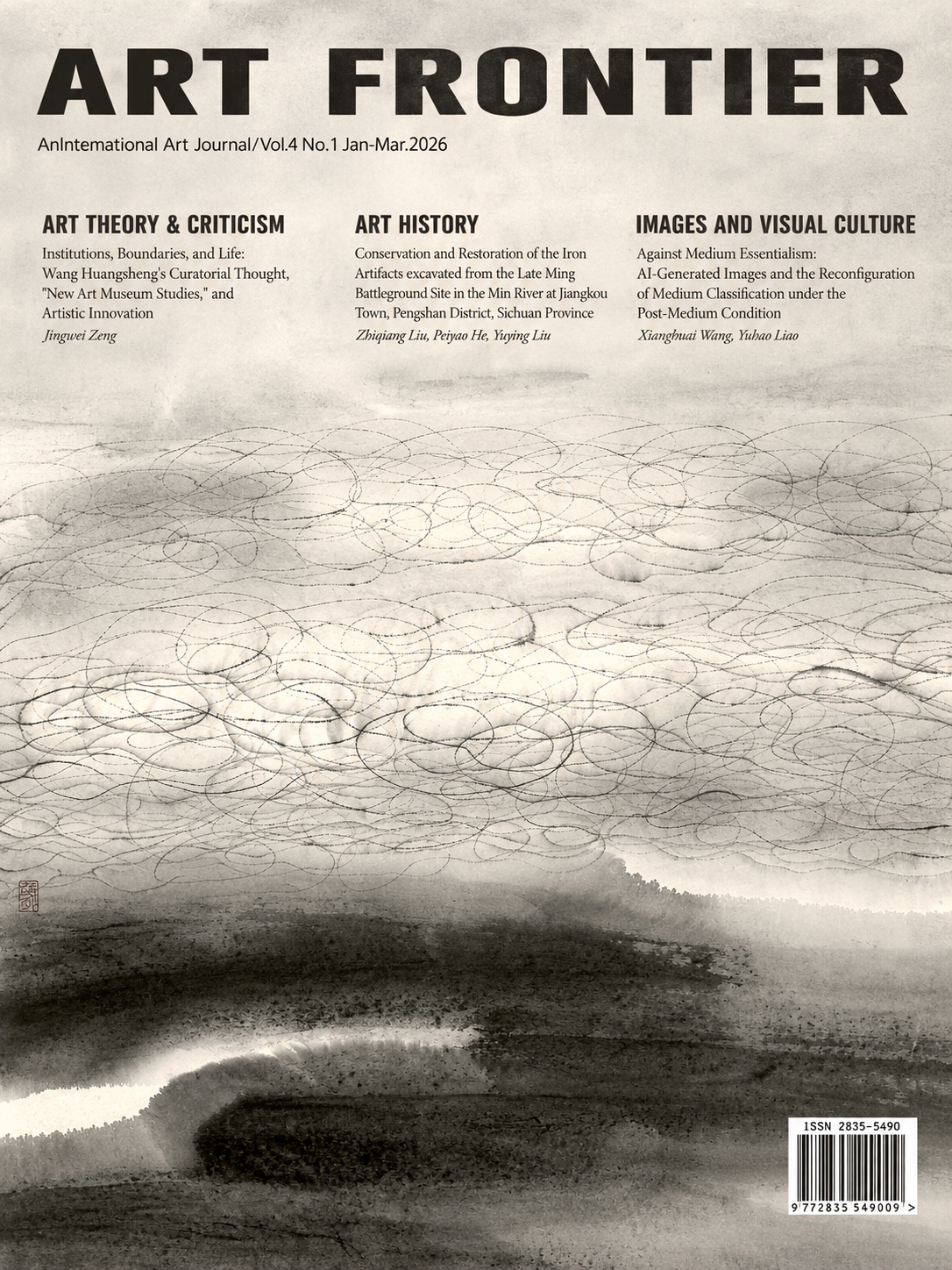
Modern Exploration and Practice of Chinese Ink Art in the Late 20th Century: A Case Study of Du Dakai
DOI:
https://doi.org/10.64212/0ycjsf83Keywords:
Du Dakai, ink art, modernity, block-surface structure, formal compositionAbstract
Du Dakai is a representative artist in the field of contemporary Chinese ink. He began to do ink creation in 1990, and it was not until he changed his creative direction at the age of 47, thus starting more than 30 years of artistic innovation. This article sorts out the development and creation of Du Dakai’s ink art, mainly from four aspects: artistic source, language innovation, subject broadening, and aesthetic pursuit. The study found that Du Dakai did interdisciplinary work such as decoration, murals and design in his early years, which brought unique formal conception and surface expression techniques to his ink creation. He put forward the three-no principles of “never repeat the ancients, never repeat others, never repeat oneself”, which shows that he actively pursues artistic modernity. In addition, he chooses a variety of contents such as countryside, exotic, human body, still life, etc., which broadens the scope of ink painting. Guided by the aesthetic ethos of “depicting ordinary things with an ordinary mind”, he bridged the estrangement between traditional Chinese painting and contemporary lived reality. Du Dakai’s ink practice offers a referable pathway for the contemporary transformation of Chinese painting: it firmly preserves the cultural essence of ink as a medium while absorbing formal vocabularies of Western modern art with an open vision, pursuing a creative synthesis between tradition and contemporaneity, and between Eastern and Western artistic paradigms.